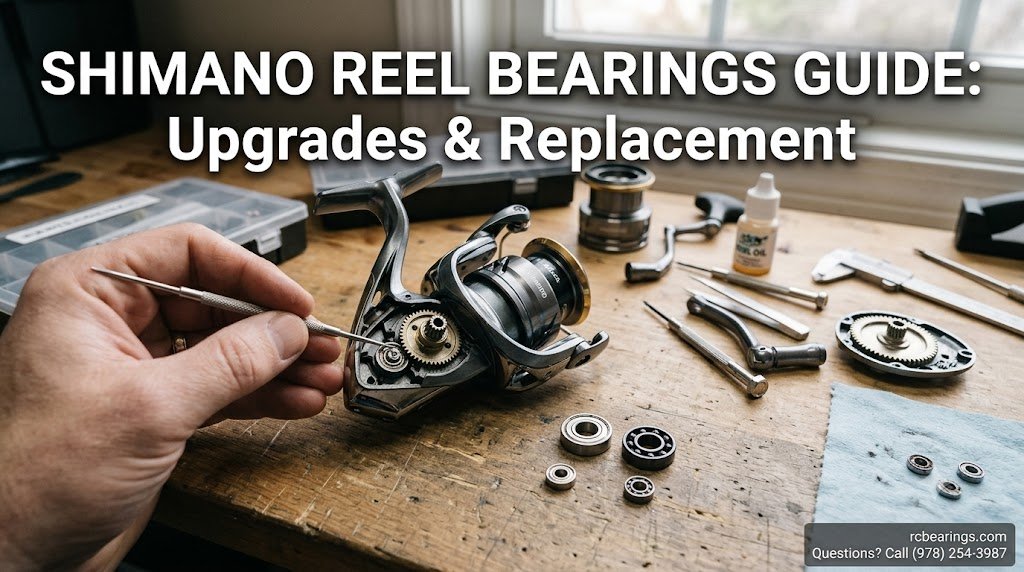
Shimano reel bearings are known for tight tolerances straight from the factory, which is part of why Shimano reels cast so smoothly when new. But like any precision component, those bearings wear down over time, and knowing how to source the right shimano replacement bearings keeps a good reel performing the way it was designed to. Why Shimano Reels Rely So Heavily on Bearing Quality Shimano builds much of its reel performance reputation around smooth, low-friction spool rotation, which depends almost entirely on bearing quality and precision fit. A worn or corroded bearing has an outsized effect on a Shimano reel specifically, since the rest of the reel’s engineering is built around expecting that level of smoothness — a rough bearing stands out more on a Shimano than it might on a budget reel with looser tolerances everywhere else. Common Bearing Locations on Shimano Reels Each location may use a different bearing size, so identifying exactly which bearing needs replacing before ordering saves time and avoids mismatched parts. Steel vs Ceramic Shimano Replacement Bearings Standard steel shimano replacement bearings restore factory-level performance at a reasonable price point, which is the right call for most anglers doing routine maintenance. Anglers chasing maximum casting distance — surf casters, tournament anglers — often upgrade to ceramic or hybrid ceramic bearings in the spool position specifically, since that’s where reduced friction has the biggest impact on cast length. How to Identify the Correct Shimano Bearing Size Shimano doesn’t always print bearing dimensions directly on the part, so the most reliable method is measuring the old bearing’s bore, outer diameter, and width with a caliper before ordering a replacement. These measurements correspond to standard bearing sizing conventions set by the American Bearing Manufacturers Association, which makes cross-referencing available replacement options straightforward once you have accurate numbers. Signs Shimano Reel Bearings Need Replacing Maintaining Shimano Bearings Between Replacements Regular cleaning with a bearing-safe solvent, followed by light re-lubrication, extends the life of Shimano bearings considerably — especially for anglers fishing saltwater, where corrosion is the leading cause of premature bearing failure. Skipping this maintenance is one of the most common reasons anglers end up needing a full bearing replacement sooner than expected. Ceramic Upgrades Across Shimano’s Reel Lineup Ceramic bearing upgrades work across nearly all Shimano reel types — spinning, baitcasting, and conventional — though the performance benefit is most noticeable in reels used for distance casting or high-speed retrieve techniques. Anglers running Shimano reels for finesse fishing or shorter-range presentations may not notice as dramatic a difference, since casting distance matters less in those techniques than it does for surf casting or open-water presentations. Final Thoughts Shimano reels reward good bearing maintenance more than most, given how much of their performance depends on smooth rotation. If you’re not sure which bearing size or grade fits your specific Shimano model, send us the details and we’ll help confirm the right fit. Shop Fishing Reel Bearings → [https://rcbearings.com/fishing-reel-kits/] Questions about fitment? Call (978) 254-3987 — we’re happy to confirm before you buy.
Abu Garcia Bearings Guide: Replacement & Ceramic Upgrades
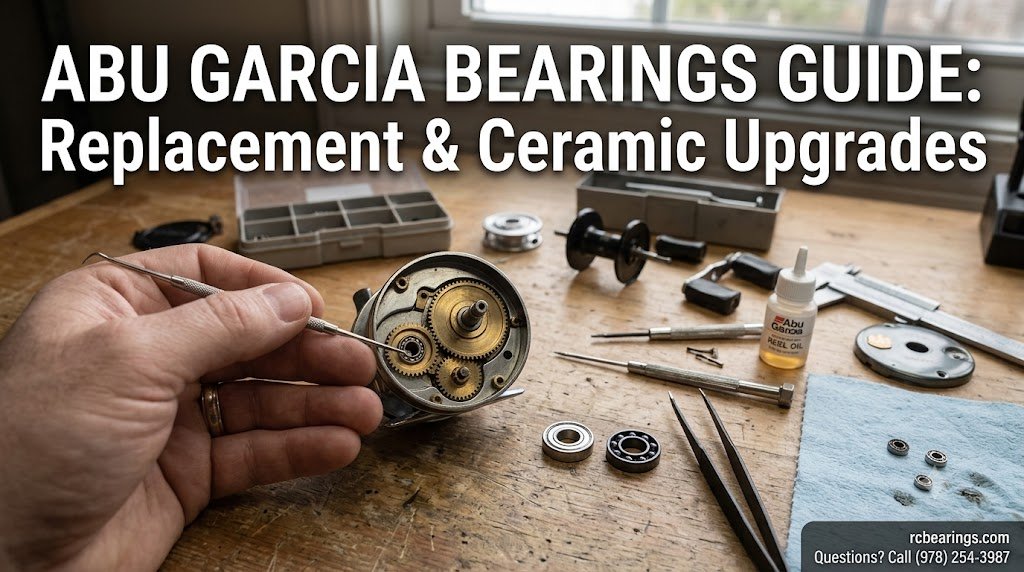
Anglers rebuilding an Abu Garcia reel eventually run into the same question: which abu garcia bearings actually fit, and is it worth upgrading to ceramic while you’re already inside the reel? Abu Garcia has produced reels across dozens of models and generations, so getting the bearing swap right means matching more than just “close enough” dimensions. What Bearings Does an Abu Garcia Reel Use? Most Abu Garcia reels, including the long-running Ambassadeur line, use small precision ball bearings supporting the spool, pinion gear, and handle shaft. Ambassadeur bearings in particular are sized to tight tolerances since the whole reel’s casting performance depends on how freely the spool spins. Older Ambassadeur models sometimes used bushings instead of full ball bearings in certain positions — a detail worth checking before ordering abu garcia replacement bearings, since a bushing and a ball bearing aren’t interchangeable without the correct spacer or seat. Steel vs Ceramic Abu Garcia Replacement Bearings Standard steel replacement bearings restore a reel to factory performance at a reasonable cost, and for most recreational anglers, that’s all that’s needed. Abu garcia ceramic bearings take it a step further — ceramic balls reduce friction noticeably more than steel, which translates to longer, smoother casts and less resistance during the initial spool acceleration on a cast. The tradeoff is cost: ceramic upgrades run higher than steel, so the decision usually comes down to how much casting distance and smoothness matters for your specific use — tournament anglers and distance casters tend to see the ceramic upgrade pay off faster than casual weekend anglers. Ambassadeur Bearings: What to Check Before Ordering Before ordering ambassadeur replacement bearings, confirm the reel’s specific model and year, since Abu Garcia has changed internal bearing sizing across different generations of the Ambassadeur line. The safest approach is measuring the old bearing directly — bore, outer diameter, and width — rather than assuming based on the reel’s general model name. These dimensional conventions follow tolerance classes established by the American Bearing Manufacturers Association. Signs Your Abu Garcia Reel Needs New Bearings How Often Should Abu Garcia Bearings Be Serviced? Anglers fishing saltwater regularly should plan on inspecting or servicing bearings at least once a season, since saltwater exposure accelerates corrosion even on sealed bearings. Freshwater anglers can typically go longer between services, though periodic cleaning and re-lubrication still extends bearing life significantly regardless of water type. Reel Value and Bearing Investment Many older Abu Garcia Ambassadeur reels hold their value well and remain sought after by collectors and serious anglers alike, which makes a bearing rebuild a reasonable investment compared to replacing the reel entirely. A full bearing service on a vintage Ambassadeur often costs a fraction of what a comparable new reel would run, while preserving a reel that many anglers consider superior in build quality to modern equivalents. Final Thoughts Whether you’re restoring an older Ambassadeur or upgrading a newer Abu Garcia reel to ceramic for extra casting distance, matching the exact bearing size and choosing the right material makes the difference between a reel that performs like new and one that still feels a little off. If you’re not sure which abu garcia bearings your reel needs, send us the model and we’ll confirm fitment before you order. Shop Abu Garcia & Fishing Reel Bearings → [https://rcbearings.com/fishing-reel-kits/] Questions about fitment? Call (978) 254-3987 — we’re happy to confirm before you buy.
Folding Knife Bearings Guide: Caged vs Tumbled + OneWheel
It’s an unlikely pairing, but folding knife bearings and OneWheel bearings actually have something in common — both rely on small precision bearings to deliver smooth motion, and in both cases, upgrading or replacing that bearing makes a bigger difference than most people expect. How Folding Knife Bearings Work A folding knife’s pivot uses small bearings, usually caged ball bearings, to let the blade swing open and closed smoothly, replacing the friction washers found in older or budget knife designs. Off grid knives tumbled folding bearings and similar tumbled-finish bearings are popular in the knife community because the tumbling process removes the cage, allowing the balls to roll more freely and eliminating any drag from a caged retainer — resulting in a noticeably smoother, faster action. Caged vs Tumbled Folding Knife Bearings Most premium folding knives from the last several years use one of these two bearing styles instead of traditional washers, which is part of why modern folders open so much more smoothly than older designs. Bearing dimensions used in knife pivots generally follow standard miniature bearing sizing set by the American Bearing Manufacturers Association. OneWheel Bearings and Motor Maintenance OneWheel bearings support the motor and axle assembly that the entire board’s balance and propulsion depend on. Because a One Wheel’s motor bearing takes on constant load, vibration, and — depending on riding conditions — dirt and moisture exposure, these bearings tend to wear faster than bearings in less demanding applications. Electric motor bearings in general, including those used in OneWheel-style devices, need to handle a specific combination of radial load, some axial load, and often exposure to electrical current from the motor windings, which is why sealed, non-conductive, or ceramic hybrid bearings are frequently preferred over standard steel in these motor applications. Standard steel motor bearing designs can be susceptible to electrical pitting over time from stray current passing through the bearing. Signs a Motor Bearing Needs Replacing Maintaining Folding Knife Pivot Bearings Knife pivot bearings benefit from occasional cleaning with a light solvent to remove pocket lint and debris, followed by a small drop of light oil. Over-oiling is a common mistake — too much oil attracts more dirt than it prevents, which can actually slow the pivot down over time rather than improve it. Choosing Between Steel and Ceramic for Knife Pivots Steel bearings are the standard, affordable choice for most folding knife pivots and hold up well under normal use. Ceramic or hybrid ceramic pivot bearings are a popular upgrade for knife enthusiasts chasing an even smoother, faster action, since ceramic’s lower friction is especially noticeable in a small, low-load application like a knife pivot compared to steel. Final Thoughts Whether you’re upgrading a folding knife’s pivot for smoother action or servicing worn OneWheel motor bearings, matching the correct size and style makes all the difference in performance and longevity. If you’re not sure which bearing fits your knife or board, reach out with the details and we’ll help you find the right match. Shop Precision & Motor Bearings → [https://rcbearings.com/shop-list-view/] Questions about fitment? Call (978) 254-3987 — we’re happy to help.
Medical Device Bearings Guide: Food & Mining Applications Too
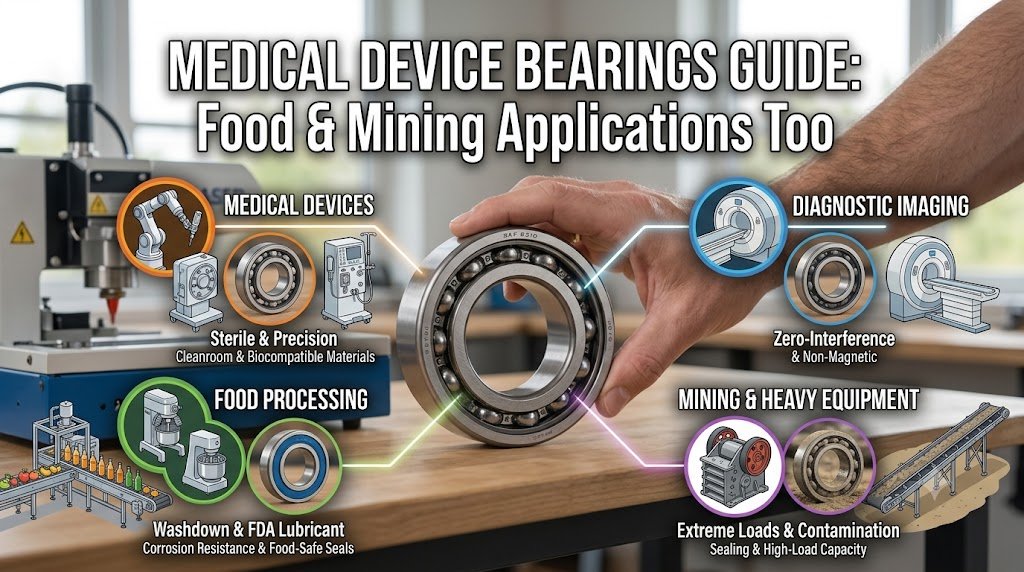
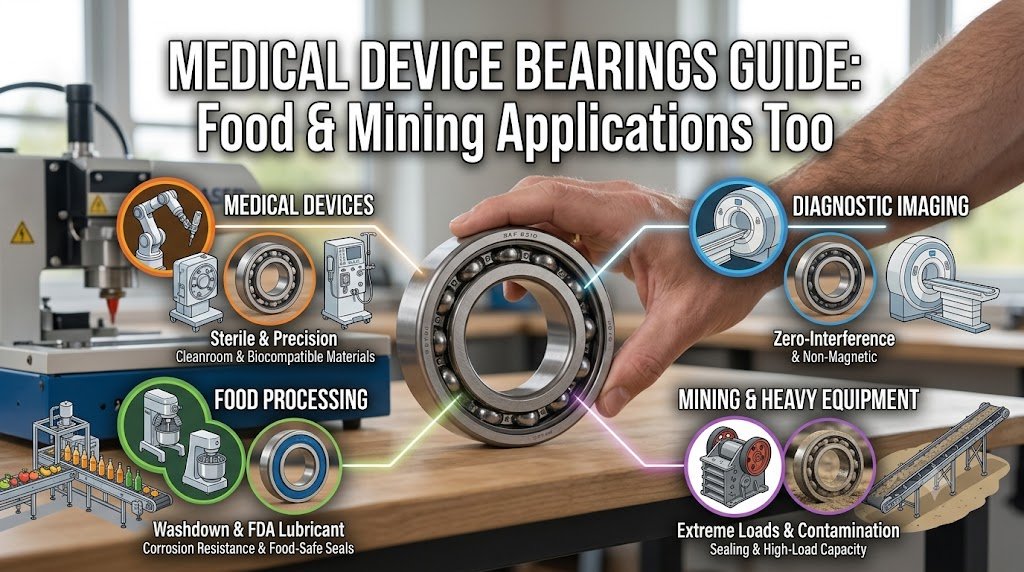
Not every industry can use standard commercial bearings — some environments demand corrosion resistance, sterilizability, or extreme durability that general-purpose bearings simply aren’t built for. Medical device bearings, food-grade bearings, and mining equipment bearings each have their own specific requirements shaped by the environment they operate in. What Makes a Bearing Suitable for Medical Devices? As a bearing supplier for medical applications, we work with requirements that go well beyond standard industrial tolerances. Medical device bearings, including dental device ball bearings used in high-speed handpieces and precision instruments, need to be: A high precision medical device bearing supplier needs to understand both the mechanical requirements and the sterilization or regulatory environment the bearing will operate in, since a bearing that performs well mechanically but degrades under autoclave sterilization isn’t a viable long-term solution. Bearings for the Food & Beverage Industry Bearings for the food & beverage industry face a different but related challenge — constant wash-down cycles, exposure to cleaning chemicals, and strict sanitation requirements. Standard carbon steel bearings corrode quickly under these conditions, which is why stainless steel and non-corrosive ball bearings are the standard choice for food processing equipment. A non corrosive ball bearings manufacturer needs to account not just for moisture exposure, but for the specific cleaning chemicals commonly used in food-grade sanitation protocols. Bearings for Mining Equipment At the opposite end of the spectrum, bearings for mining equipment suppliers need to prioritize raw durability over precision. Mining equipment bearings face extreme dirt and dust contamination, heavy shock loading, and continuous heavy-duty operation, often in remote locations where frequent maintenance isn’t practical. Sealed, heavy-duty bearing designs with robust contamination protection matter more here than tight tolerances. Choosing the Right Industrial Bearing Supplier Whether you’re sourcing for a medical device, a food processing line, or mining equipment, the right bearing depends on matching material and seal type to the specific environmental demands of the application — sanitation and biocompatibility for medical, corrosion resistance for food-grade, and contamination protection combined with load capacity for mining. Dimensional and quality standards across all three industries generally reference tolerance classes set by the American Bearing Manufacturers Association. Traceability and Documentation Requirements Medical and food-grade bearing applications often require material traceability and certification documentation that general industrial bearings don’t need. When sourcing bearings for these industries, confirming documentation availability upfront saves delays later in a regulated procurement process. Lead Times and Sourcing Considerations Specialized bearings for medical, food-grade, or mining applications often require longer lead times than standard commercial bearings, particularly when custom certifications or material traceability documents are needed. Planning procurement well ahead of an installation or maintenance window helps avoid production delays, especially for mining operations in remote locations where a missing part can halt equipment for days rather than hours. Final Thoughts These three industries have very different requirements, but they share one thing in common: standard commercial bearings usually aren’t sufficient. If you’re sourcing bearings for a medical, food-grade, or mining application, reach out with your specific requirements and we’ll help you find the right fit. Shop Industrial & Specialty Bearings → [https://rcbearings.com/shop-list-view/] Questions about your application? Call (978) 254-3987 — we’re happy to help.
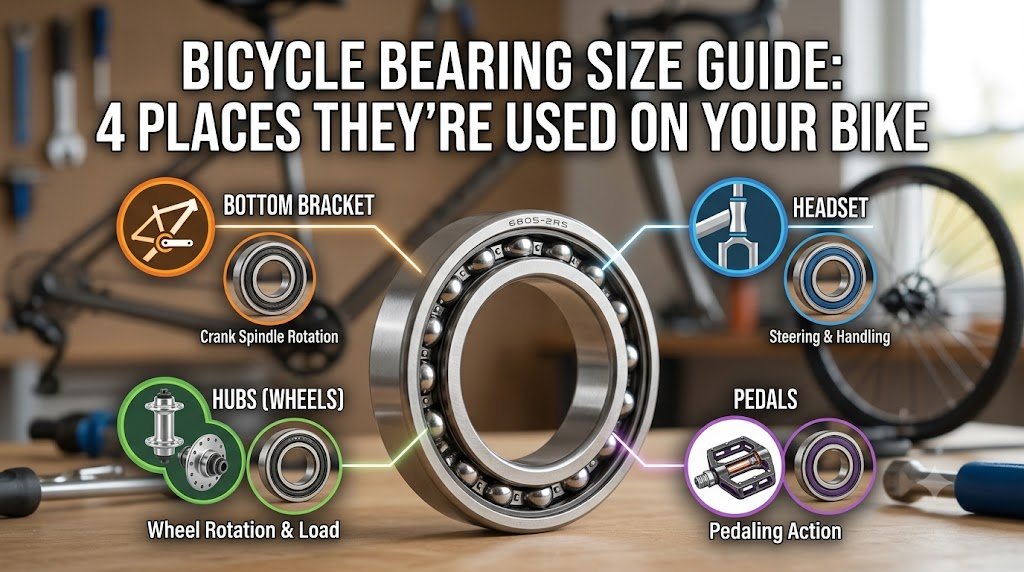
Bicycle Bearing Size Guide: 4 Places They’re Used on Your Bike
A single bicycle bearing does a lot of work — every rotating point on a bike relies on bearings to keep things spinning smoothly under constant load, vibration, and weather exposure. Knowing where bearings live on a bike and how to size them correctly makes maintenance a lot less intimidating. 4 Places Bearings Are Used on a Bicycle Each location uses different bike bearing sizes depending on the bike’s design, manufacturer, and age, which is why bearings from one part of the bike are almost never interchangeable with another. Common Bike Bearing Sizes Bicycle bearings are typically sealed cartridge bearings sized to fit standardized hub, bottom bracket, and headset dimensions. Common sizes include small cartridge bearings for hubs and headsets, and slightly larger sizes for bottom brackets, depending on whether the frame uses a threaded or press-fit bottom bracket standard. Because there’s meaningful variation between bike brands and bottom bracket standards, matching your specific bike’s existing bearing dimensions is more reliable than assuming based on bike type alone. These dimensional conventions generally align with tolerance classes set by the American Bearing Manufacturers Association. Sealed vs Loose Ball Bearings Older and budget bikes sometimes still use loose ball bearings held in a retainer, requiring grease and periodic adjustment. Most modern bikes use sealed cartridge bearings instead — a self-contained unit that’s simpler to replace and holds up better against dirt and water intrusion, since the loose-ball design has more exposure points for contamination to enter. Signs a Bicycle Bearing Needs Replacing How Riding Conditions Affect Bearing Life Bikes ridden in rain, mud, or on gravel wear through bearings faster than bikes kept to dry pavement, since water and grit work their way past seals over time even on well-sealed cartridge bearings. Riders in wetter climates should plan on checking hub and bottom bracket bearings more frequently than the general maintenance interval suggests. DIY Replacement vs Shop Service Hub and headset bearings on bikes with standard sizes are often replaceable at home with basic tools, while press-fit bottom brackets sometimes require a specific bearing press tool that many home mechanics don’t have on hand. If you’re not confident identifying the correct bearing standard for your bottom bracket, a local shop can usually confirm it quickly, but sourcing the actual replacement part yourself is often more affordable than a shop-supplied bearing. Final Thoughts Bicycle bearings take a lot of abuse for how little attention they get — road grit, rain, and constant load all add up over time. If you’re replacing a hub, bottom bracket, or headset bearing and aren’t sure which size fits your bike, send us the details and we’ll help confirm the correct part. Whether you’re maintaining a daily commuter or a race bike, matching the correct bearing size and seal type keeps your bike rolling smoothly for years rather than requiring frequent repeat repairs. Shop Bicycle Bearings → [https://rcbearings.com/shop-list-view/] Questions about fitment? Call (978) 254-3987 — we’re happy to help.
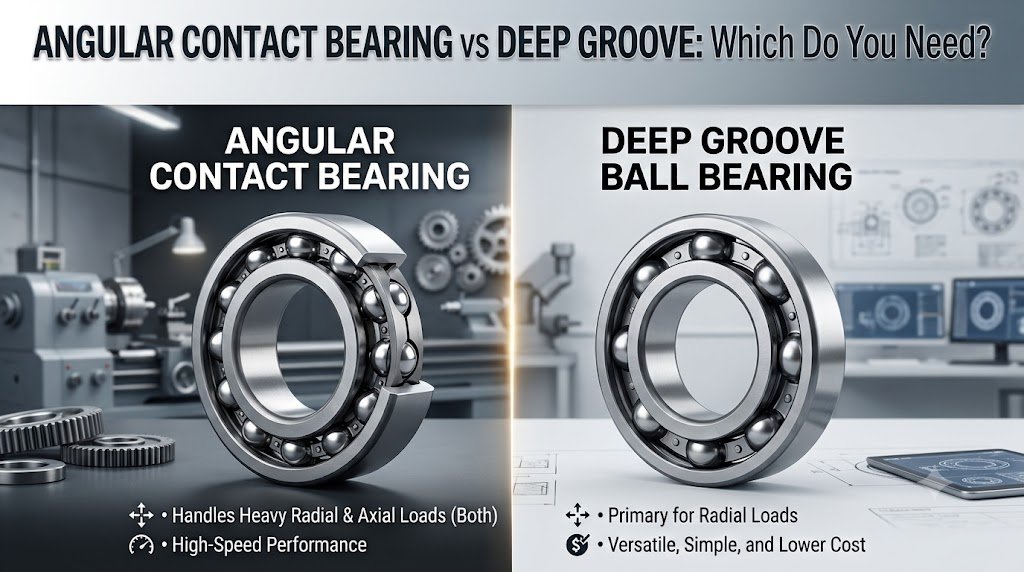
Angular Contact Bearing vs Deep Groove: Which Do You Need?
Choosing between an angular contact bearing and a deep groove radial ball bearing comes down to one core question: which direction is the load actually coming from? These two bearing types are built for genuinely different load conditions, and using the wrong one for the application leads to premature wear or outright failure. What Is an Angular Contact Bearing? An angular contact bearing is designed so the contact line between the ball and the races sits at an angle relative to the bearing’s axis, rather than straight across. This design allows angular bearings to handle combined radial and axial (thrust) loads simultaneously — something a standard radial bearing isn’t built to do well. Angular contact bearings are common in applications with significant axial load alongside rotation, such as pump shafts, machine tool spindles, and steering assemblies, where the bearing needs to resist being pushed sideways along the shaft, not just support radial weight. What Is a Deep Groove Radial Ball Bearing? A deep groove radial ball bearing is the most common bearing type in general use — the balls sit in deep, curved grooves in the inner and outer races, primarily supporting radial load (perpendicular to the shaft) with some capacity for light axial load in either direction. This design is versatile, affordable, and handles moderate speed and load well, which is why it’s the default choice across most general-purpose mechanical and industrial applications. Angular Contact vs Deep Groove: Which Do You Need? Using an angular contact bearing where a simple deep groove bearing would suffice adds unnecessary cost and installation complexity. Using a deep groove bearing where significant thrust load is present will lead to premature failure as the bearing struggles to handle load it wasn’t designed for. What Are Flanged Bearings? Flanged ball bearings include a flange (a small lip) around the outer race, which allows the bearing to be mounted directly into a housing bore without additional retaining hardware. Flanged bearings simplify mounting and provide automatic axial positioning within a housing, which is useful in compact assemblies where adding a separate retaining clip or shoulder isn’t practical. Both angular contact and deep groove designs are available in flanged variants depending on the mounting need. Manufacturing Standards for Angular Contact Bearings Tolerance and dimensional standards for angular contact and deep groove bearings both generally follow classifications set by the American Bearing Manufacturers Association, which helps ensure consistent fit and performance across different manufacturers and suppliers. Single vs Paired Angular Contact Bearings Angular contact bearings are frequently installed in matched pairs, arranged either back-to-back or face-to-face depending on the load direction expected. A single angular contact bearing can only resist axial thrust load in one direction, so applications with thrust load in both directions typically require a paired arrangement to fully support the shaft. Final Thoughts Understanding whether your application needs an angular contact bearing, a deep groove radial ball bearing, or a flanged variant of either comes down to analyzing the actual load direction and mounting constraints. If you’re not sure which type fits your application, reach out with the details and we’ll help you choose correctly. Shop Precision Ball Bearings → [https://rcbearings.com/ball-bearings/] Questions about your application? Call (978) 254-3987 — we’re happy to help.
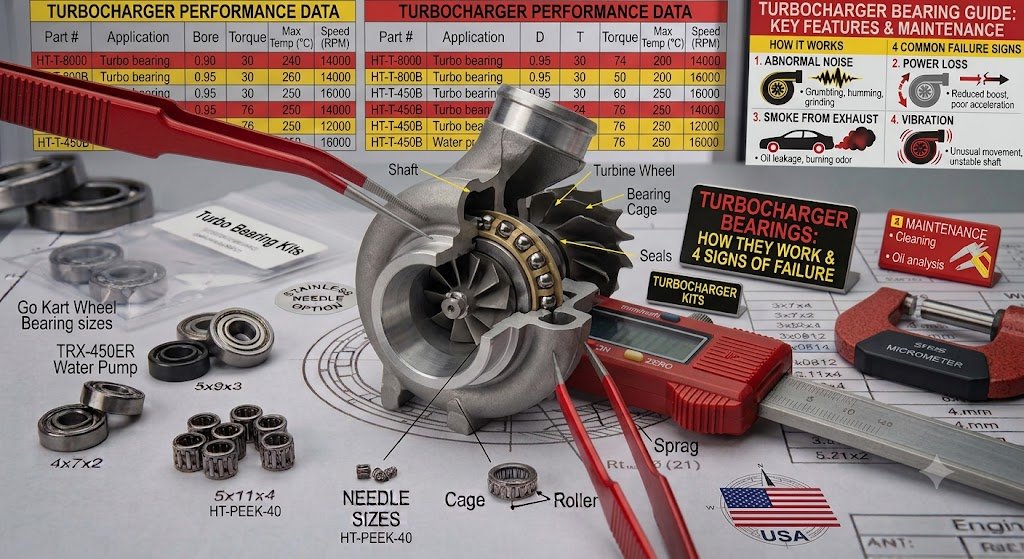
Turbocharger Bearings: How They Work & 4 Signs of Failure
Few bearing applications are as demanding as a turbocharger. Turbocharger bearings routinely spin at over 100,000 RPM while sitting inches from exhaust gas temperatures that can exceed 1,000°F — a combination of speed and heat that most bearing designs simply can’t survive. How Turbocharger Bearings Work A turbocharger’s turbine and compressor wheels sit on opposite ends of a single shaft, spun by exhaust gas on one side and compressing intake air on the other. The bearings supporting that shaft need to handle extreme rotational speed, significant heat soak from the nearby exhaust turbine, and constant lubrication demands, since a turbo shaft with no oil film for even a few seconds at full RPM can suffer catastrophic bearing failure. Most factory turbochargers use a journal bearing design — essentially a bushing riding on a pressurized oil film rather than a traditional ball bearing. It’s durable and handles heat well, but it creates more internal friction, which contributes to turbo lag on acceleration. Ball Bearing Turbochargers: What’s Different? Ball bearing turbochargers replace the journal bearing design with actual ball bearings supporting the shaft. This reduces internal friction significantly compared to a journal bearing design, which translates to faster turbo spool-up and reduced lag — a big part of why ball bearing turbochargers are popular in performance and racing applications where throttle response matters as much as peak boost. The tradeoff is that ball bearing turbo designs are generally more expensive to manufacture and can be less tolerant of oil starvation than a journal bearing design, making consistent, high-quality lubrication even more critical for long-term reliability. 4 Signs Your Turbocharger Bearings Are Failing What Causes Premature Turbo Bearing Failure The vast majority of turbo bearing failures trace back to oil supply issues — infrequent oil changes, using the wrong oil weight, or shutting an engine off immediately after hard driving without letting the turbo cool and stop spinning first. Since turbo bearings rely entirely on that oil film for lubrication and cooling, oil quality and supply matter more here than in almost any other bearing application. Manufacturing tolerances for turbo bearing components generally follow standards set by the American Bearing Manufacturers Association. Extending Turbocharger Bearing Life Letting a turbocharged engine idle for 30-60 seconds before shutdown allows the turbo to cool and slow down while still receiving oil flow, which significantly reduces the risk of heat-related bearing damage from oil coking inside the housing. Aftermarket vs OEM Turbo Bearings When rebuilding a turbo, matching OEM tolerances closely matters more than chasing the cheapest available bearing kit. A bearing that’s slightly out of spec can throw off shaft balance at the extreme RPMs turbos operate at, leading to vibration and premature failure even if the part technically “fits.” Sourcing from a supplier that verifies fitment against OEM specs is worth the extra step for a component running under this much stress. Final Thoughts Turbocharger bearings operate under some of the harshest conditions any bearing faces, which is why proper lubrication and timely replacement at the first sign of wear matter so much. If you’re sourcing replacement bearings for a turbo rebuild, reach out with the specifics and we’ll help you find the right fit. Shop Precision Bearings → [https://rcbearings.com/shop-list-view/] Questions about your application? Call (978) 254-3987 — we’re happy to help.
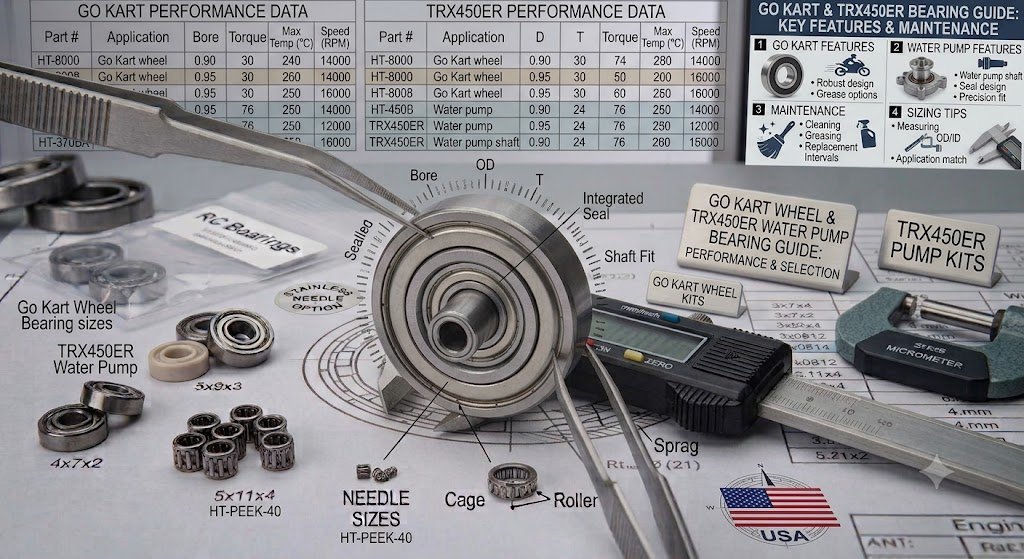
Go Kart Wheel Bearing & TRX450ER Water Pump Bearing Guide
Whether you’re chasing down a noisy wheel on a go-kart or dealing with a leaking water pump on a Honda TRX450ER, both problems usually trace back to a worn bearing that’s cheap and quick to replace — if you know exactly which one you need. Go Kart Wheel Bearing Basics A go kart wheel bearing sees a different kind of abuse than most wheel bearings — high lateral load through corners, frequent impacts from track curbs or off-road terrain, and in a lot of cases, minimal sealing from dirt and debris. Go cart bearings are typically small sealed or shielded ball bearings pressed into the wheel hub, and their small size means even minor wear shows up quickly as noticeable play. Signs a Go Kart Wheel Bearing Is Worn TRX450ER Water Pump Bearing Replacement The water pump bearing trx450er owners search for is a common failure point on this model, and it typically shows signs of wear well before the pump fails completely. Watch for coolant leaking from the weep hole below the water pump housing, a grinding or whining noise coming from the water pump area, or noticeable play in the water pump shaft when checked with the cover removed. The water pump bearing sits between the impeller shaft and the housing, sealing coolant on one side from engine oil on the other. When the bearing wears, the seal next to it usually fails too, which is why a water pump rebuild often replaces both the bearing and seal together rather than the bearing alone. Getting the exact OEM-matched size is important here, since a bearing that’s even slightly off tolerance can cause the seal to fail prematurely again. Choosing the Right Bearing for Both Applications Both TRX450ER water pump bearings and go-kart wheel bearings benefit from sealed (2RS) designs over open or shielded bearings, since both applications are exposed to contamination — coolant and oil on one side, dirt and debris on the other. Matching exact OEM dimensions matters more than upgrading to a bearing that doesn’t fit the housing tolerance correctly, and sizing standards for both generally follow conventions set by the American Bearing Manufacturers Association. Why Go-Kart Bearings Wear Faster Than Expected Go-kart wheel bearings often wear faster than riders expect because karts run without any suspension to absorb impacts — every bump, curb strike, or hard landing transmits directly into the wheel bearing. Riders who race regularly should plan on inspecting wheel bearings more often than they would on a suspended vehicle of similar weight. Preventive Maintenance for Both Applications Regularly inspecting wheel bearings for play and checking water pump function during routine maintenance — rather than waiting for a failure — catches most problems while they’re still a simple bearing swap instead of a more involved repair. For race karts especially, a quick pre-race check of wheel play takes only a minute and can prevent a mid-race failure. Final Thoughts Both of these are common, inexpensive fixes once you have the correct bearing size in hand. If you’re not sure which bearing matches your TRX450ER or your specific go-kart wheel hub, send us the details and we’ll confirm the right part before you order. Shop Powersports & Go-Kart Bearings → [https://rcbearings.com/shop-list-view/] Questions about fitment? Call (978) 254-3987 — we’re happy to help.
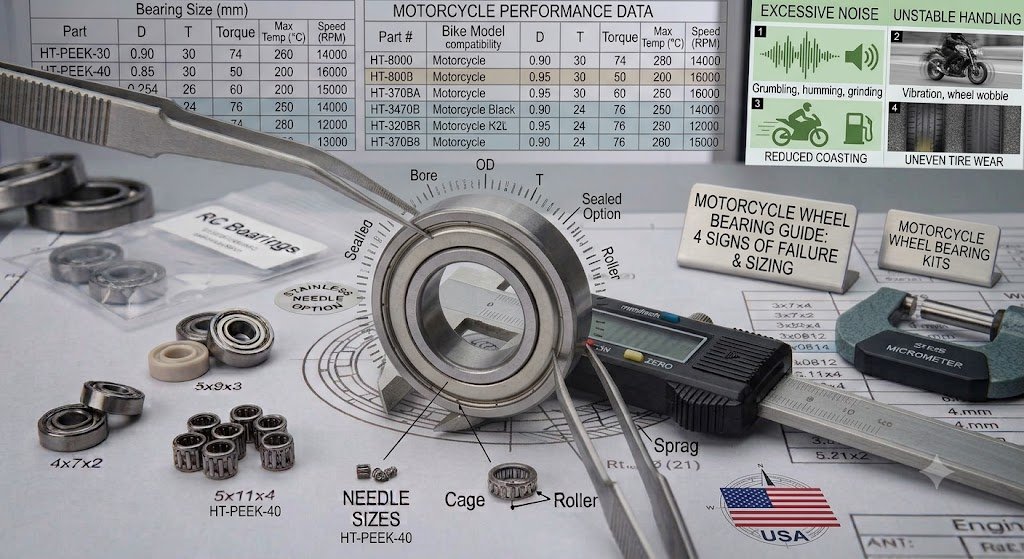
Motorcycle Wheel Bearing Guide: 4 Signs of Failure & Sizing
A worn motorcycle wheel bearing doesn’t always announce itself right away — it often starts as a faint hum at speed that riders write off as tire noise, until it gets loud enough that it can’t be ignored. Catching wheel bearing wear early matters, since a failed bearing can lead to wheel wobble or, in worse cases, wheel lockup at speed. 4 Signs of a Failing Motorcycle Wheel Bearing Motorbike wheel bearings take on constant vibration and road debris exposure, and unlike a car, there’s very little suspension isolation protecting the wheel bearing from that punishment — which is part of why they tend to wear faster than automotive wheel bearings of a similar size. Common Motorcycle Wheel Bearing Sizes Motorcycle wheel bearings are typically sealed, deep-groove ball bearings sized to the specific hub design of the bike. A general wheel bearing size chart reference includes common sizes like 6204, 6205, and 6304 series bearings, though exact fitment varies significantly by make, model, and year. Always confirm against your bike’s service manual or the bearing currently installed rather than assuming based on bike category alone. These size and tolerance conventions follow classifications set by the American Bearing Manufacturers Association. Sealed vs Shielded Bearings for Motorcycle Wheels Because motorcycle wheels are exposed to road spray, dirt, and wash-down water, sealed (2RS) bearings are generally the better choice over shielded (ZZ) bearings for wheel applications — the rubber seal keeps contamination out far more effectively than a metal shield alone, especially for bikes ridden in rain or washed frequently. How to Replace a Motorcycle Wheel Bearing Wheel bearing replacement typically involves removing the wheel, pressing the old bearing out of the hub, and pressing the new one in — a job that’s straightforward with the right tools but easy to damage the hub with if done without a proper bearing press or driver set. Getting the exact size and seal type right before starting the job saves a second trip to source the correct part, and it’s worth replacing both bearings on a wheel at the same time even if only one shows symptoms, since the other is usually close behind. Front vs Rear Wheel Bearing Wear Rear wheel bearings on most motorcycles tend to wear faster than front bearings, since they carry more load from acceleration and chain or belt tension. If you’re only checking one wheel, the rear is usually the better place to start looking for early signs of wear. Tools Needed for a Wheel Bearing Job A basic wheel bearing replacement typically requires the wheel removed from the bike, a bearing puller or drift set to remove the old bearing, and a bearing driver or socket sized to the new bearing’s outer race for installation. Attempting the job with improvised tools — like hammering directly on the bearing — is one of the most common ways to damage a hub, so it’s worth borrowing or renting proper tools if you don’t already have them. Final Thoughts A motorcycle wheel bearing that’s starting to hum or show play is worth addressing before it affects handling or safety. If you’re not sure which size or seal type your bike needs, send us the make, model, and year — or the bearing you’re replacing — and we’ll confirm the correct fit. Shop Motorcycle Wheel Bearings → [https://rcbearings.com/shop-list-view/] Questions about fitment? Call (978) 254-3987 — we’re happy to help.
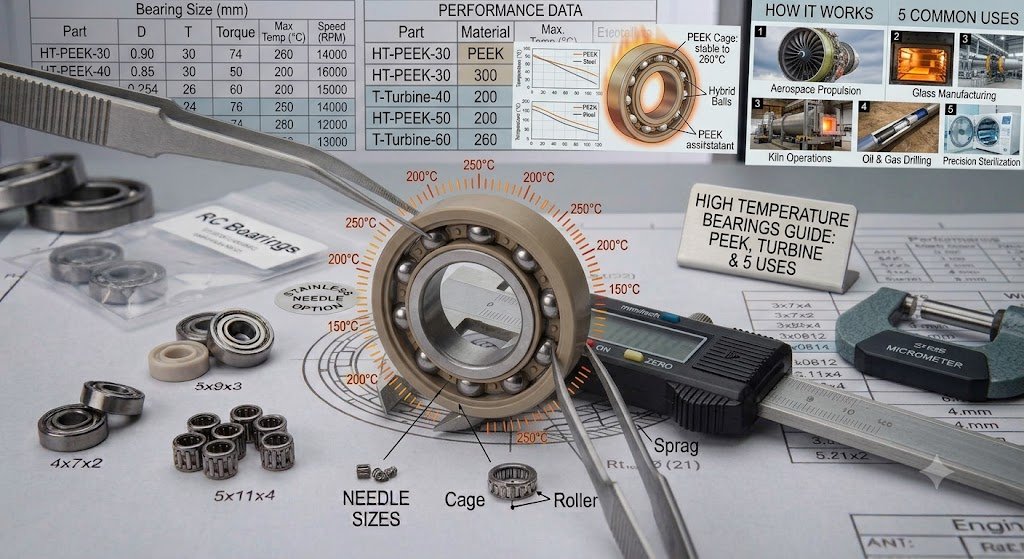
High Temperature Bearings Guide: PEEK, Turbine & 5 Uses
Standard bearings aren’t built to survive sustained exposure to extreme heat — the lubrication breaks down, seals degrade, and metal components can lose dimensional stability. High temperature bearings are engineered specifically to keep performing reliably where standard bearings would fail. Why Standard Bearings Fail Under Heat Most standard ball bearings rely on grease or oil lubrication that has a defined temperature ceiling — once exceeded, the lubricant thins out, breaks down, or burns off entirely, leaving the bearing to run dry and wear out rapidly. Standard rubber seals (2RS) also degrade or melt under sustained high heat, letting contamination in and lubricant out, which accelerates failure even further. How High Temperature Bearings Are Built Differently High temperature bearings address these failure points through several design changes: PEEK Bearings: A Different Approach to Heat and Chemical Resistance Bearing grade PEEK (polyether ether ketone) is a high-performance polymer used in specialized bearing applications where heat resistance needs to be combined with chemical resistance or reduced weight. PEEK bearings are especially useful in environments where standard lubricated metal bearings would be compromised by chemical exposure, or where a lubrication-free design is preferred for cleanliness, such as food processing or medical equipment. While PEEK bearings don’t typically match steel’s raw load capacity, they excel in applications prioritizing heat tolerance, chemical resistance, and low-maintenance operation over maximum load capacity. 5 Common Uses for High Temperature Bearings Turbine Bearings and Extreme Operating Conditions Turbine bearings represent one of the most demanding use cases for high-temperature bearing technology — sustained high RPM combined with significant heat generation requires bearings engineered specifically for that combination, often using advanced ceramic or hybrid ceramic construction alongside specialized high-temperature lubrication systems. Manufacturing tolerances for these bearings typically follow standards set by the American Bearing Manufacturers Association. Choosing the Right High-Temperature Bearing The right choice depends on the specific combination of heat, load, chemical exposure, and speed your application involves. A bearing rated for high heat but low speed won’t necessarily perform well in a high-RPM turbine application, and vice versa, so matching all four factors together matters more than optimizing for heat resistance alone. Signs a Bearing Is Struggling With Heat A bearing running hotter than its rated range typically shows discoloration on the races (a bluish or straw tint on steel), unusually fast lubricant breakdown, or premature seal failure well before the expected service interval. Catching these signs early and switching to a properly rated high-temperature bearing prevents a small heat problem from turning into a full mechanical failure. Final Thoughts Whether you need standard high-temperature steel bearings, PEEK bearings for chemical resistance, or specialized turbine bearings, matching the bearing to your specific heat and load conditions is what determines reliable long-term performance. Reach out with your application details and we’ll help you find the right fit. Shop High-Temperature & PEEK Bearings → [https://rcbearings.com/shop-list-view/] Questions about your application? Call (978) 254-3987 — we’re happy to help.