Choosing between an angular contact bearing and a deep groove radial ball bearing comes down to one core question: which direction is the load actually coming from? These two bearing types are built for genuinely different load conditions, and using the wrong one for the application leads to premature wear or outright failure.
What Is an Angular Contact Bearing?
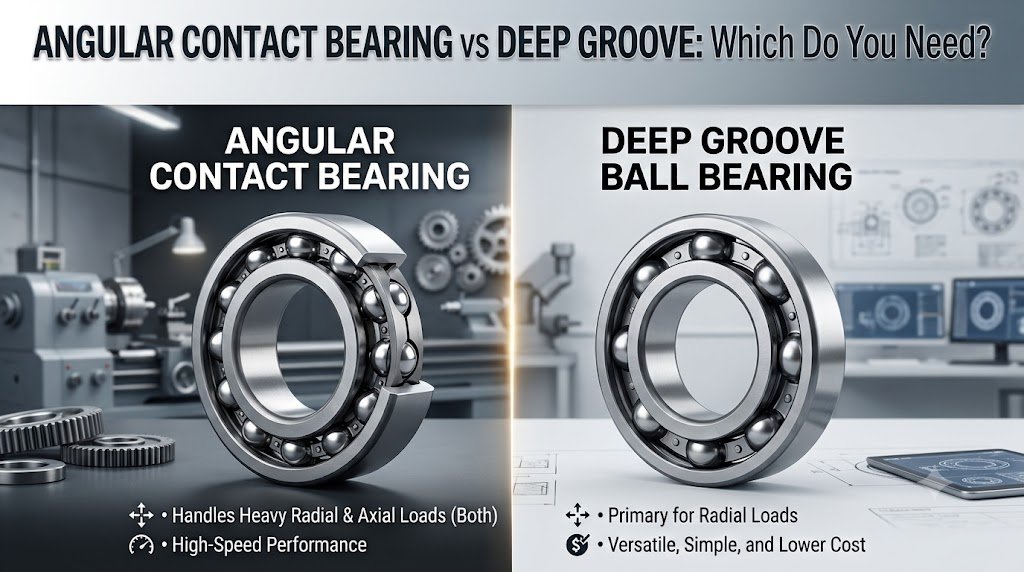
An angular contact bearing is designed so the contact line between the ball and the races sits at an angle relative to the bearing’s axis, rather than straight across. This design allows angular bearings to handle combined radial and axial (thrust) loads simultaneously — something a standard radial bearing isn’t built to do well.
Angular contact bearings are common in applications with significant axial load alongside rotation, such as pump shafts, machine tool spindles, and steering assemblies, where the bearing needs to resist being pushed sideways along the shaft, not just support radial weight.
What Is a Deep Groove Radial Ball Bearing?
A deep groove radial ball bearing is the most common bearing type in general use — the balls sit in deep, curved grooves in the inner and outer races, primarily supporting radial load (perpendicular to the shaft) with some capacity for light axial load in either direction. This design is versatile, affordable, and handles moderate speed and load well, which is why it’s the default choice across most general-purpose mechanical and industrial applications.
Angular Contact vs Deep Groove: Which Do You Need?
- Choose an angular contact bearing when your application has significant combined radial and axial (thrust) load, or when precise axial positioning matters, since these bearings are often used in matched pairs for exactly that reason
- Choose a deep groove radial ball bearing for general-purpose applications where radial load dominates and axial load is minimal
Using an angular contact bearing where a simple deep groove bearing would suffice adds unnecessary cost and installation complexity. Using a deep groove bearing where significant thrust load is present will lead to premature failure as the bearing struggles to handle load it wasn’t designed for.
What Are Flanged Bearings?
Flanged ball bearings include a flange (a small lip) around the outer race, which allows the bearing to be mounted directly into a housing bore without additional retaining hardware. Flanged bearings simplify mounting and provide automatic axial positioning within a housing, which is useful in compact assemblies where adding a separate retaining clip or shoulder isn’t practical. Both angular contact and deep groove designs are available in flanged variants depending on the mounting need.
Manufacturing Standards for Angular Contact Bearings
Tolerance and dimensional standards for angular contact and deep groove bearings both generally follow classifications set by the American Bearing Manufacturers Association, which helps ensure consistent fit and performance across different manufacturers and suppliers.
Single vs Paired Angular Contact Bearings
Angular contact bearings are frequently installed in matched pairs, arranged either back-to-back or face-to-face depending on the load direction expected. A single angular contact bearing can only resist axial thrust load in one direction, so applications with thrust load in both directions typically require a paired arrangement to fully support the shaft.
Final Thoughts
Understanding whether your application needs an angular contact bearing, a deep groove radial ball bearing, or a flanged variant of either comes down to analyzing the actual load direction and mounting constraints. If you’re not sure which type fits your application, reach out with the details and we’ll help you choose correctly.
Shop Precision Ball Bearings → [https://rcbearings.com/ball-bearings/]
Questions about your application? Call (978) 254-3987 — we’re happy to help.