Standard bearings aren’t built to survive sustained exposure to extreme heat — the lubrication breaks down, seals degrade, and metal components can lose dimensional stability. High temperature bearings are engineered specifically to keep performing reliably where standard bearings would fail.
Why Standard Bearings Fail Under Heat
Most standard ball bearings rely on grease or oil lubrication that has a defined temperature ceiling — once exceeded, the lubricant thins out, breaks down, or burns off entirely, leaving the bearing to run dry and wear out rapidly. Standard rubber seals (2RS) also degrade or melt under sustained high heat, letting contamination in and lubricant out, which accelerates failure even further.
How High Temperature Bearings Are Built Differently
High temperature bearings address these failure points through several design changes:
- High-temperature grease or dry lubrication rated for extended heat exposure well beyond standard grease limits
- Metal shields (ZZ) instead of rubber seals, which hold up under heat that would degrade rubber
- Specialized steel alloys that maintain dimensional stability and hardness at elevated temperatures
- Ceramic or hybrid ceramic construction, which naturally tolerates higher heat than standard steel
PEEK Bearings: A Different Approach to Heat and Chemical Resistance
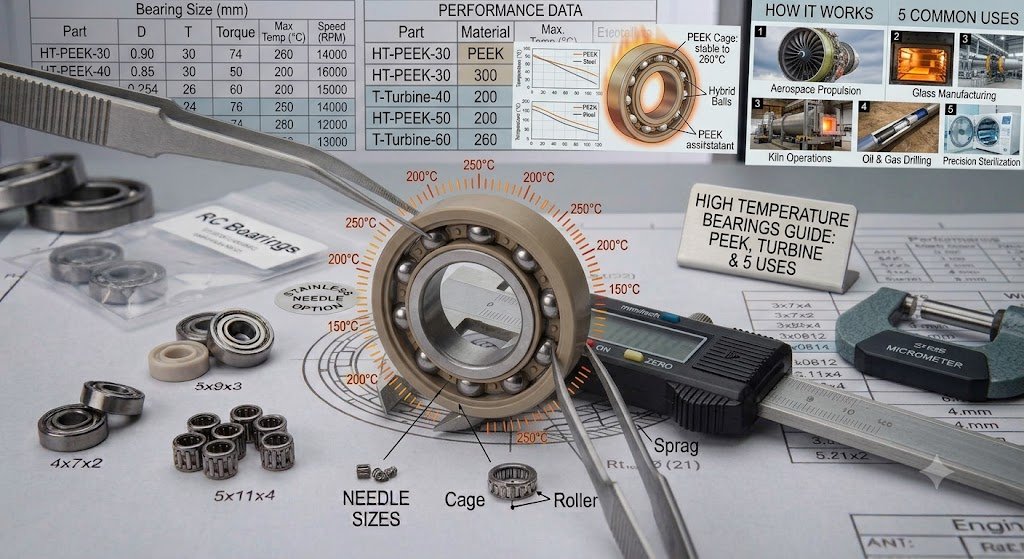
Bearing grade PEEK (polyether ether ketone) is a high-performance polymer used in specialized bearing applications where heat resistance needs to be combined with chemical resistance or reduced weight. PEEK bearings are especially useful in environments where standard lubricated metal bearings would be compromised by chemical exposure, or where a lubrication-free design is preferred for cleanliness, such as food processing or medical equipment.
While PEEK bearings don’t typically match steel’s raw load capacity, they excel in applications prioritizing heat tolerance, chemical resistance, and low-maintenance operation over maximum load capacity.
5 Common Uses for High Temperature Bearings
- Industrial ovens and kilns
- Turbine and generator assemblies
- Exhaust and emissions equipment
- Food processing equipment near heat sources
- High-speed motors that generate significant internal heat
Turbine Bearings and Extreme Operating Conditions
Turbine bearings represent one of the most demanding use cases for high-temperature bearing technology — sustained high RPM combined with significant heat generation requires bearings engineered specifically for that combination, often using advanced ceramic or hybrid ceramic construction alongside specialized high-temperature lubrication systems. Manufacturing tolerances for these bearings typically follow standards set by the American Bearing Manufacturers Association.
Choosing the Right High-Temperature Bearing
The right choice depends on the specific combination of heat, load, chemical exposure, and speed your application involves. A bearing rated for high heat but low speed won’t necessarily perform well in a high-RPM turbine application, and vice versa, so matching all four factors together matters more than optimizing for heat resistance alone.
Signs a Bearing Is Struggling With Heat
A bearing running hotter than its rated range typically shows discoloration on the races (a bluish or straw tint on steel), unusually fast lubricant breakdown, or premature seal failure well before the expected service interval. Catching these signs early and switching to a properly rated high-temperature bearing prevents a small heat problem from turning into a full mechanical failure.
Final Thoughts
Whether you need standard high-temperature steel bearings, PEEK bearings for chemical resistance, or specialized turbine bearings, matching the bearing to your specific heat and load conditions is what determines reliable long-term performance. Reach out with your application details and we’ll help you find the right fit.
Shop High-Temperature & PEEK Bearings → [https://rcbearings.com/shop-list-view/]
Questions about your application? Call (978) 254-3987 — we’re happy to help.