If you’ve been shopping for abec 9 bearings and wondering whether they’re actually better than abec 7 bearings for your application, you’re not alone — the ABEC rating is one of the most misunderstood specs in the bearing world. It gets used constantly in marketing for skateboard wheels, fidget spinners, and RC parts, but most of that marketing skips over what ABEC actually measures.
What Does ABEC Actually Measure?
ABEC stands for Annular Bearing Engineering Committee, and the rating (1, 3, 5, 7, 9) refers to manufacturing tolerance — specifically, how precisely the bearing’s dimensions and roundness are controlled during production, based on ABMA and ISO tolerance standards. A higher ABEC number means tighter manufacturing tolerances, not necessarily higher speed capability or load capacity.
That’s the part most product listings get wrong. An abec 9 bearing is manufactured to a tighter tolerance than an abec-7 bearing, but tolerance alone doesn’t determine how well a bearing performs under load, at high speed, or in a dirty environment — those depend on material, lubrication, and seal type just as much as ABEC rating.
ABEC 7 Bearings vs ABEC 9 Bearings: What’s the Real Difference?
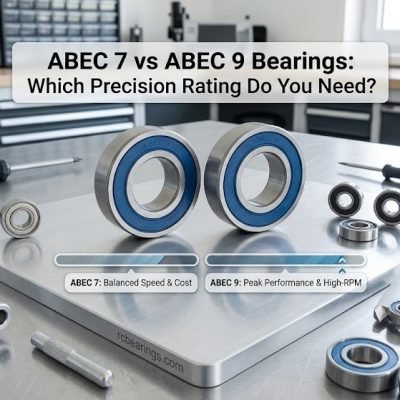
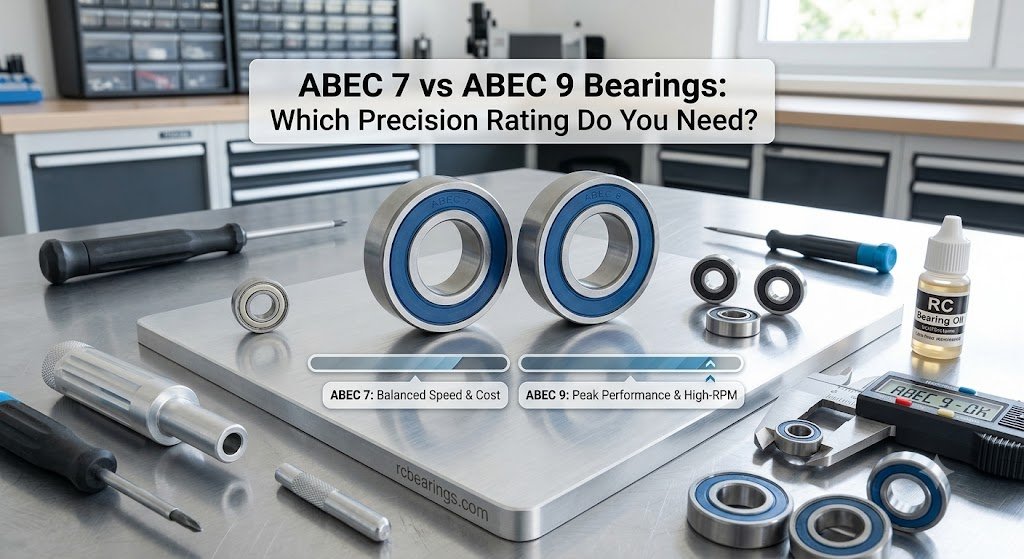
- ABEC 7 bearings are manufactured to a tight tolerance suitable for most high-performance applications — skateboards, RC cars, fidget spinners, precision motors.
- ABEC 9 bearings are manufactured to an even tighter tolerance, which can translate to smoother rotation and slightly less vibration at very high RPM, but the practical difference is often smaller than marketing suggests for casual use.
For most hobbyist applications, the jump from ABEC 7 to ABEC 9 matters most when the bearing is running at sustained high RPM — a spinning fidget spinner, a high-speed RC motor, or precision industrial equipment. For lower-speed applications like standard skateboard wheels, the difference is often negligible.
Does a Higher ABEC Rating Mean a Better Bearing?
Not automatically. A poorly sealed, low-quality abec 9 bearing can wear out faster and perform worse than a well-made abec 7 bearing with good shielding and proper lubrication. Tolerance is one factor among several — material grade, seal type (2RS vs ZZ), and ball material (steel vs ceramic) all matter just as much for real-world performance and longevity.
Which ABEC Rating Should You Choose?
- Choose ABEC 7 for most everyday high-performance applications where cost matters
- Choose ABEC 9 when you need the tightest tolerance available for very high-speed or precision-critical use
- Prioritize seal type and material for anything exposed to dirt, moisture, or heavy load
Final Thoughts
ABEC rating is a useful spec, but it’s only one part of choosing the right bearing. If you’re not sure whether abec 7 bearings or abec 9 bearings are the right fit for your specific application, reach out with the details and we’ll help you match the right bearing — not just the highest number.
Shop Precision Bearings → [https://rcbearings.com/ball-bearings/]
Questions about which rating fits your build? Call (978) 254-3987 — we’re happy to help.