Stainless steel needle bearings solve a problem that standard ball bearings can’t — fitting serious load capacity into a very tight radial space. If you’ve ever needed a bearing for a compact assembly where a standard ball bearing simply wouldn’t fit, a needle bearing is almost always the answer. This guide covers how they work, where they’re used, and how to size a replacement correctly.
What Makes a Needle Bearing Different?
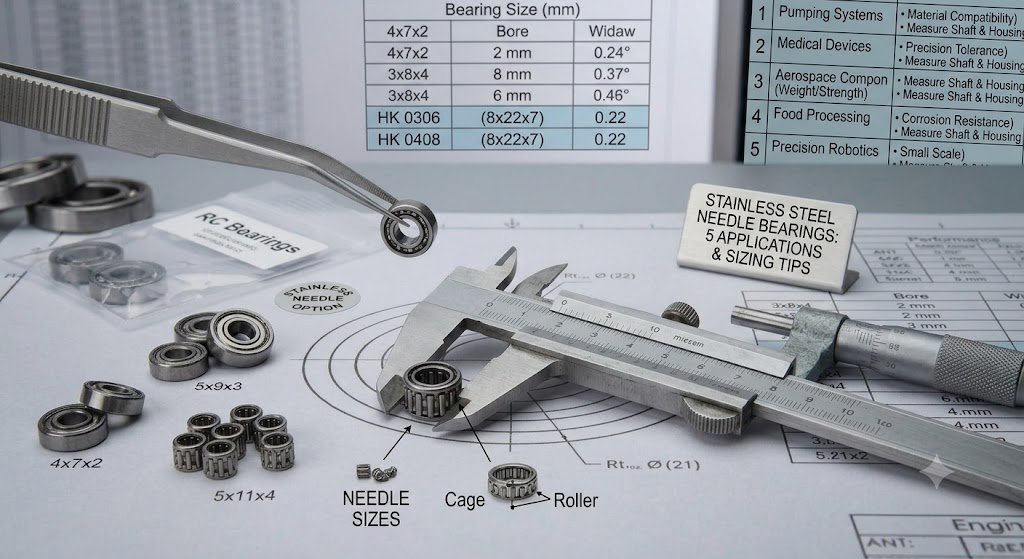
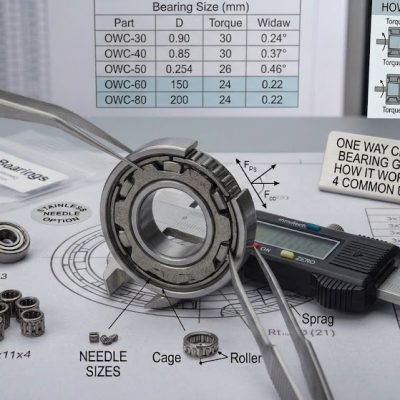
Unlike ball bearings, which use round balls to reduce friction, a needle bearing uses long, thin cylindrical rollers (the “needles”) arranged around the shaft. This design allows the bearing to have a much smaller outer diameter relative to its load capacity compared to a standard ball bearing, since the needles distribute load across a longer contact line rather than a single point. Dimensional and tolerance standards for these bearings generally follow guidelines set by the American Bearing Manufacturers Association.
Why Choose Stainless Steel Over Standard Needle Bearings?
A stainless needle bearing offers the same compact, high-load design as a standard needle bearing, with significantly better corrosion resistance. This makes stainless steel needle bearings the preferred choice in demanding environments where standard carbon steel would corrode quickly.
5 Common Applications for Stainless Steel Needle Bearings
- Marine equipment — wash-down and saltwater exposure demand corrosion resistance
- Food and beverage processing machinery — frequent sanitation cycles require rust-proof components
- Medical devices — corrosion resistance and sterilizability matter as much as mechanical performance
- Outdoor equipment — exposure to moisture and weather shortens the life of standard steel bearings
- Transmission and small engine assemblies — compact spaces where high load capacity is still required
Standard carbon steel needle bearings will rust under any of these conditions over time, while stainless steel versions hold up for years without corrosion-related failure.
Choosing the Right Needle Bearing Size
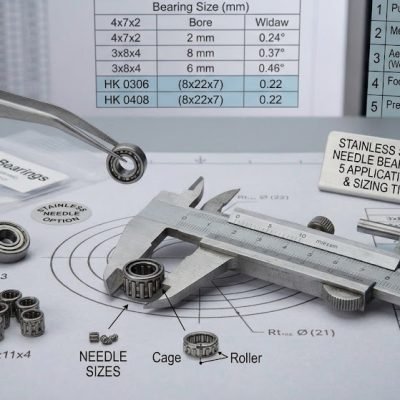
Like ball bearings, needle bearings are specified by bore, outer diameter, and width — but because the internal design is different, needle bearing sizing tables aren’t interchangeable with ball bearing sizing charts. If you’re replacing an existing needle bearing, matching the exact dimensions matters, and so does confirming whether it’s a caged, full-complement, or drawn-cup design, since each type mounts and performs slightly differently.
Caged vs Full-Complement Needle Bearings
A caged needle bearing holds the rollers in fixed positions with a retainer, which limits maximum load capacity slightly but reduces friction and allows higher speeds. A full-complement design packs in more needles without a cage, increasing load capacity at the cost of a lower maximum speed rating. Choosing between the two depends on whether your application prioritizes speed or raw load capacity.
Installation Tips for Needle Bearings
Needle bearings are more sensitive to misalignment during installation than ball bearings, since the long roller contact line means even slight tilting during press-fit can damage the races. Using a proper bearing press or driver sized to the outer race — never pressing on the needles or cage directly — helps avoid this. Confirming the shaft and housing bore are clean and free of burrs before installation also reduces the risk of premature wear right after replacement.
Final Thoughts
For compact, high-load applications — especially in wet, corrosive, or sanitary environments — stainless steel needle bearings are usually the right call over both standard needle bearings and traditional ball bearings. If you’re not sure which size or configuration your application needs, send us the details and we’ll help you find the right match.
Shop Needle Bearings → [https://rcbearings.com/shop-list-view/]
Questions about sizing or fitment? Call (978) 254-3987 — we’re happy to help.