Industrial bearings USA buyers source for manufacturing plants, conveyor systems, pumps, and motors are the kind of component you only think about when something goes wrong. When a production line stops mid-shift, a pump starts throwing vibration, or a motor runs hot — nine times out of ten, a bearing is the culprit. And yet, despite being the backbone of rotating equipment across American manufacturing floors, industrial bearings remain one of the most under-researched purchases most facilities and engineers make.
RCBearings has spent over 30 years supplying industrial bearings USA customers trust — with roots in Nashua, New Hampshire and a distribution network reaching Lowell, Massachusetts, throughout New Hampshire, and all 50 states. Here’s what every engineer, plant manager, and maintenance buyer should understand before placing their next order.
What Are Industrial Bearings USA Manufacturers and Engineers Actually Buying?
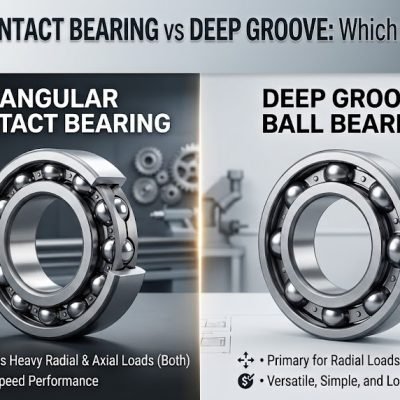
At their core, industrial bearings USA facilities use are precision components designed to allow controlled motion between two surfaces — typically a rotating shaft and its housing — while carrying radial loads, axial loads, or both. Deep groove ball bearings are the most widely used type, but the category also includes angular contact bearings for combined load scenarios, cylindrical roller bearings for heavier radial loads, and thrust bearings for purely axial applications.
The quality variation within industrial bearings USA buyers encounter is enormous, and it almost always comes down to three things: the steel grade used, the tolerances held during manufacturing, and the seal or shield protecting the internal components. Two bearings that look identical on the shelf can perform completely differently in the field — one running cleanly for years, the other pitting, vibrating, and failing within months.
What Is ABEC Tolerance Class, and Does It Matter?
If you’ve ever seen ratings like ABEC-1, ABEC-3, ABEC-5, or ABEC-7 on bearing documentation, those refer to the Annular Bearing Engineers’ Committee tolerance standards widely used across the USA. Higher ABEC numbers indicate tighter manufacturing tolerances — closer dimensional accuracy on bore, outer diameter, width, and runout.
For general industrial applications like electric motors, pumps, fans, and conveyor rollers, ABEC-1 and ABEC-3 are typically adequate. As you move into higher-speed or higher-precision equipment — machine tool spindles, precision instrumentation, robotics — ABEC-5 and above become relevant.
The mistake many buyers make is defaulting to the highest tolerance class available. In reality, the added cost of tighter tolerances is only justified when the application genuinely demands it. For most industrial bearings USA plants run day-to-day, well-manufactured ABEC-1 or ABEC-3 bearings from a quality domestic supplier will outperform cheaper, poorly made ABEC-5 bearings every single time.
Steel Grade: Why AISI 52100 Is the Benchmark for Industrial Bearings USA
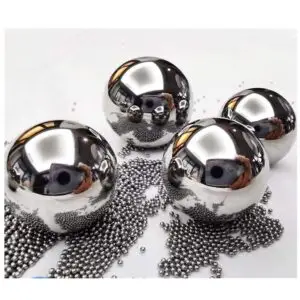
Quality industrial bearings USA buyers should look for are manufactured from AISI 52100 bearing steel — also known as GCR-15 or 100Cr6. This alloy steel is specifically formulated for bearing applications, heat-hardened to a Rockwell hardness of approximately 59–64, and processed through grinding and polishing steps that produce the smooth, precise surfaces bearings need to perform reliably under sustained load.
This heat treatment process is not cosmetic. It’s what gives the bearing race and ball surfaces the hardness needed to resist micro-fatigue under repeated loading cycles — and it’s one of the first steps cut in lower-quality bearings. If a bearing hasn’t been properly through-hardened to spec, it will wear far faster than expected regardless of what the product listing says.
When to Specify Stainless Steel for Industrial Bearings USA Applications
Standard AISI 52100 bearing steel handles the vast majority of industrial applications cleanly. But there are environments where corrosion resistance matters as much as wear resistance — food and beverage processing, outdoor equipment, wet environments, marine applications, and anywhere chemical washdowns are routine.
For these environments, 440C stainless steel bearings are the correct specification. Made from heat-hardened stainless stock, they offer corrosion resistance that standard carbon steel simply can’t match while still delivering comparable hardness and wear performance. For facilities across Massachusetts and New Hampshire where seasonal humidity and temperature swings accelerate corrosion on improperly specified components, stainless industrial bearings can extend maintenance intervals significantly.
Seals vs. Shields: Choosing the Right Protection for Your Environment
The right seal choice for industrial bearings USA facilities select depends entirely on operating environment — and it has a direct impact on how long a bearing lasts.
Metal shields (the “ZZ” designation) reduce drag and dissipate heat efficiently, making them suitable for higher-speed, cleaner environments. Rubber seals (the “RS” or “2RS” designation) create a tighter contact against the inner race — better protection against dust, debris, and moisture, making them the right choice for dirtier or wetter production environments.
For most general industrial applications in New Hampshire and Massachusetts facilities, double-sealed bearings (2RS) strike the best balance between contamination protection and acceptable drag at operating speeds.
The Real Cost of Cutting Corners on Industrial Bearings USA Plants Rely On
It’s tempting to treat industrial bearings USA buyers source as a commodity and shop purely on price. But the true cost of a bearing purchase isn’t the unit price — it’s the total cost of downtime, labor, and secondary damage when it fails prematurely.
A bearing that fails on a production line doesn’t just cost the price of the replacement. It costs the labor to diagnose and fix the failure, the downtime during the repair, and any secondary damage to shafts, housings, or adjacent components. Buying industrial bearings USA equipment depends on from a supplier with genuine quality control is one of the most straightforward ways to reduce unplanned downtime. The savings on a cheap bearing rarely offset the cost of the failure.
Why Domestic Sourcing Matters for Industrial Bearings USA Buyers
Lead times, accuracy, and accountability — these are the practical reasons why buying industrial bearings USA from a domestic supplier makes sense for most facilities.
When a bearing fails and you need a replacement to get equipment running again, waiting weeks for overseas parts is simply not an option. RCBearings in Nashua, New Hampshire stocks a wide range of industrial bearings USA businesses rely on, shipping quickly to customers in Lowell, Massachusetts, throughout New Hampshire, and all 50 states.
Beyond speed, a domestic industrial bearings USA supplier is easier to communicate with when you’re not certain which bearing matches your application. The right supplier asks the right questions about load, speed, environment, and fit — and gets you the correct part the first time.
The Bottom Line
Industrial bearings USA buyers depend on are small, precise, and critical. The difference between a good bearing and a cheap one rarely shows up on day one — it shows up six months later on the production floor. Specifying the right steel grade, tolerance class, and seal type for your actual application, sourced from a trusted industrial bearings USA supplier like RCBearings in Nashua, NH, is the kind of decision that pays for itself consistently over time.
RCBearings | 30+ Years Supplying Industrial Bearings USA-Wide | Nashua, NH | Serving Lowell MA, Massachusetts, New Hampshire & All 50 States | Call: (978) 254-3987