Few bearing applications are as demanding as a turbocharger. Turbocharger bearings routinely spin at over 100,000 RPM while sitting inches from exhaust gas temperatures that can exceed 1,000°F — a combination of speed and heat that most bearing designs simply can’t survive.
How Turbocharger Bearings Work
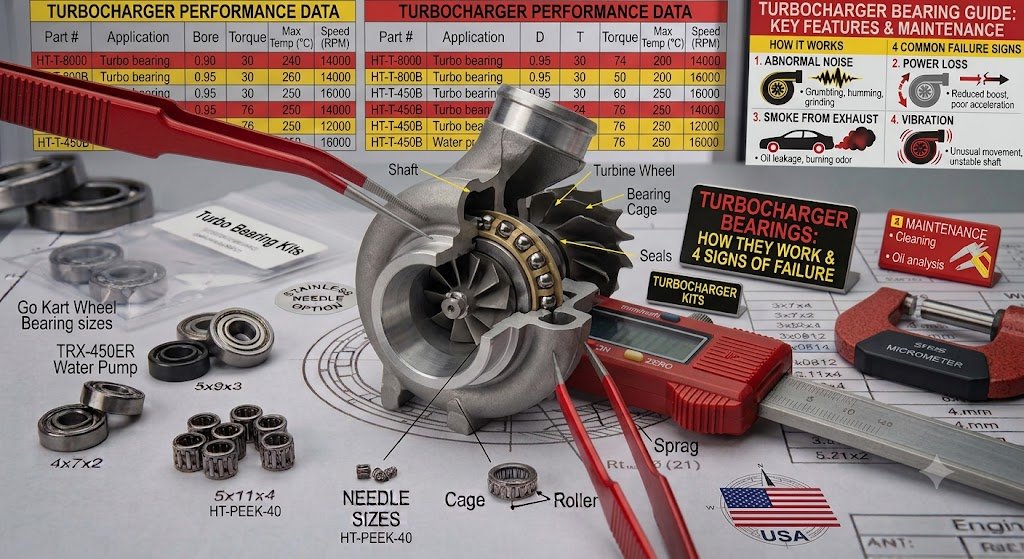
A turbocharger’s turbine and compressor wheels sit on opposite ends of a single shaft, spun by exhaust gas on one side and compressing intake air on the other. The bearings supporting that shaft need to handle extreme rotational speed, significant heat soak from the nearby exhaust turbine, and constant lubrication demands, since a turbo shaft with no oil film for even a few seconds at full RPM can suffer catastrophic bearing failure.
Most factory turbochargers use a journal bearing design — essentially a bushing riding on a pressurized oil film rather than a traditional ball bearing. It’s durable and handles heat well, but it creates more internal friction, which contributes to turbo lag on acceleration.
Ball Bearing Turbochargers: What’s Different?
Ball bearing turbochargers replace the journal bearing design with actual ball bearings supporting the shaft. This reduces internal friction significantly compared to a journal bearing design, which translates to faster turbo spool-up and reduced lag — a big part of why ball bearing turbochargers are popular in performance and racing applications where throttle response matters as much as peak boost.
The tradeoff is that ball bearing turbo designs are generally more expensive to manufacture and can be less tolerant of oil starvation than a journal bearing design, making consistent, high-quality lubrication even more critical for long-term reliability.
4 Signs Your Turbocharger Bearings Are Failing
- A high-pitched whining or whistling sound that changes with RPM
- Excessive shaft play, checked by wiggling the compressor wheel by hand with the intake piping removed
- Blue or gray smoke from the exhaust, indicating oil is leaking past worn bearing seals into the exhaust or intake
- Reduced boost pressure or noticeably slower turbo response than normal
What Causes Premature Turbo Bearing Failure
The vast majority of turbo bearing failures trace back to oil supply issues — infrequent oil changes, using the wrong oil weight, or shutting an engine off immediately after hard driving without letting the turbo cool and stop spinning first. Since turbo bearings rely entirely on that oil film for lubrication and cooling, oil quality and supply matter more here than in almost any other bearing application. Manufacturing tolerances for turbo bearing components generally follow standards set by the American Bearing Manufacturers Association.
Extending Turbocharger Bearing Life
Letting a turbocharged engine idle for 30-60 seconds before shutdown allows the turbo to cool and slow down while still receiving oil flow, which significantly reduces the risk of heat-related bearing damage from oil coking inside the housing.
Aftermarket vs OEM Turbo Bearings
When rebuilding a turbo, matching OEM tolerances closely matters more than chasing the cheapest available bearing kit. A bearing that’s slightly out of spec can throw off shaft balance at the extreme RPMs turbos operate at, leading to vibration and premature failure even if the part technically “fits.” Sourcing from a supplier that verifies fitment against OEM specs is worth the extra step for a component running under this much stress.
Final Thoughts
Turbocharger bearings operate under some of the harshest conditions any bearing faces, which is why proper lubrication and timely replacement at the first sign of wear matter so much. If you’re sourcing replacement bearings for a turbo rebuild, reach out with the specifics and we’ll help you find the right fit.
Shop Precision Bearings → [https://rcbearings.com/shop-list-view/]
Questions about your application? Call (978) 254-3987 — we’re happy to help.